


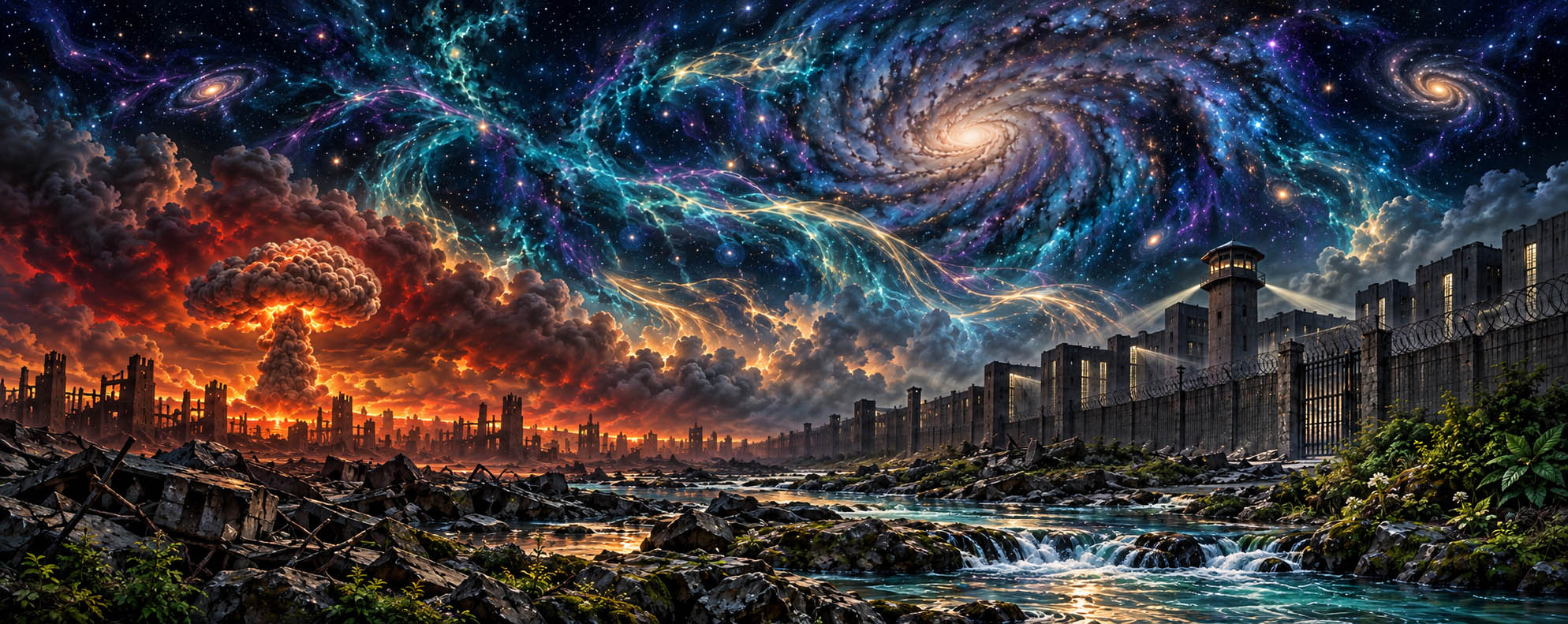
Manifesto in the Name of the Sciences of the Spirit
It can only be regretted that this discovery have come a little late, for in the name of “philosophical-scientific” materialism we have witnessed brutal dictatorships that, to name only the most disastrous, produced some 10 million victims under Lenin and Stalin, some 50 million under Mao Tse-tung, and a third of the population of Cambodia under Pol Pot, and we still see other dictatorships with concentration camps for all those who do not believe in this “scientific evidence of materialism”, and who, being in power, will scarcely accept the new theories. This, to mention only the most grotesque, but the psychic harm caused by the lack of freedom of expression, which has affected art in these materialist regimes, deserves to be highlighted: suffice it to recall the music, poetry and literature that Russia produced before the revolution, some of which was banned as decadent and contrary to material progress — such as the music of Tchaikovsky, one of the geniuses who has most clearly expressed the transcendent function of art. If the magnitude of this event is not appreciated, it is owing to the lack of understanding prevailing in our times with respect to the sciences of the spirit. (I refer the reader to The Roots of Art.)
Of course, our defence of the sciences of the spirit cannot be indiscriminate. We know all too well that man has also managed to denature these disciplines, but this is the product of dogma, which is, precisely, a consequence of the preeminence of the utilitarian faculties over the unitive ones, to the point of generating a mental blockage within discernment, which, moreover, knows only of exclusivist dualisms: God and man, spirit and nature, heaven and hell, the faithful and the unfaithful, the damned and the saved, false doctrines and true ones, and so forth; which renders it irreconcilable with the unitive faculties.
By the same mechanism, the sciences of matter, too, have fallen into the dogma of reason, which, being an external faculty, accepts as “truth” only what is verified in matter, that is to say, the “true doctrine” is materialism, of which an almost religion has come to be made.
In short, it is evident that what is respected, what predominates and what has decisively triumphed is materialism, and, what is more serious, it has come to materialise minds; that is why the neighbour has been turned into an object, Nature into an object of exploitation, reality has been reified, and there are even clear symptoms of mechanised minds to be observed in multitudes who take pleasure in listening to repetitive electronic music, literally monotonous and devoid of melody.
On the subject most discussed today, artificial intelligence, of which everyone speaks in glowing terms, I shall confine myself to pointing out its dangers. In the first place, a relationship that seems to have gone unnoticed, but which, from the perspective of my Psychosophy, becomes clear: that it is an extension of the most external faculty of reason (what I call discernment), in which contemporary man has become trapped by his obsession with material utility. This faculty is, in effect, by its nature dual, and its field does not exceed the physical world. The binary system of AI is the product of the least creative faculty we possess; it is no surprise that it has no intelligence. Although discernment, in the human being, is not disconnected from the intellect, which is nourished, at times, by feelings and intuitions that transcend reason, sufficiently to bring the spirit close to the spiritual faculties I have called unitive, because they tend towards the unification of the mind — faculties that spring from moral, aesthetic, religious and philosophical consciousness. But this is not the case with the now-famous AI, which is entirely ignorant of these higher faculties, precisely those that define us as human; for that very reason, far from it, it will tend to dehumanise us.
Of our faculties, the one in which AI proves most effective is memory, but our memory is laden with feelings and lived experiences that this apparatus does not register; far from remembering them, it will tend to make us forget that indispensable nourishment of the soul, robotising us still further. Perhaps the most harmful aspect of this invention is that it is massifying, for it serves everything up to the user ready-made, which generates in him that passive attitude so characteristic of mass man. If we are not prepared to discern and resist the influence of the media of propaganda and broadcasting, which have already indoctrinated and lulled us, if we are already “mediatised”, we shall be far less prepared to face this threat that is already under way: AI. (See The Triumph of the Masses.)
Specialisation, on the increase, is one of the characteristics of contemporary society; it may perhaps be inevitable and necessary to society, but the specialist does not seem to notice that he has become a small cog, which leads him to narrow his cultural, intellectual and spiritual horizon, to remain shut within a tiny earthly space; in other words, alienated from the universal and the perennial, that is, from philosophy. To this is added the looming threat of a present-day danger: many specialities will be replaced by AI; if the specialist is vitally bound to his profession and is then replaced, his demoralisation will be total. Perhaps now more than ever man needs the sciences of the spirit, which do not depend on novelties, which reflect the eternal in our being, what we are and what endures, and are our refuge against constant and startling change.
In truth, what we most need from present-day science and technology is that they cease producing instruments of destruction and extermination. Unfortunately, they have already created them. What the times require, then, is precisely an internal change, which is what I have been proposing for half a century. And this change is not brought about by transforming Nature (the basic premise of materialism), but by transforming our consciousness. With that premise we have inverted the order of things, the priority in the order of knowledge, which must evidently begin with the knowing subject, with the one who is, not with what surrounds him, as though we (and this is another false premise) had already attained our fulness and could dispose at will of the rest of living beings.
Material progress is inevitable, but what is avoidable is that the more progressive should not exploit the more backward, although this, as history proves, has never happened, nor will it happen until the human being changes his conduct, that is, until he emerges from his primitive mental stage of survival. In fact, he surpassed that stage long ago, but he has not overcome his mental state, and it is plain that he will not achieve this with more technology, which ceaselessly generates new means of exploitation. The answer, though we may not wish to see or accept it, is to be found in the sciences of the spirit, which, as I understand and apply them, have these as their aims: to re-establish our dignity and humanity in society and to integrate us into the World.
If we make a real act of consciousness, we shall admit that hopelessness, the lack of meaning in our existence, the very anguish we try to disguise with immediate pleasures and entertainments, and the nihilism we ourselves profess, are clear signs of inner involution. Is it not from ourselves that we wish to be distracted? Everything would seem to indicate that the more we master Nature, the more we alienate ourselves from our own nature.
It is easy to judge the physicists and the politicians who spur them on to apply their ingenuity to diabolical inventions, without taking stock of our own condition and responsibility. Everything suggests that, in our progressive identification with our external faculties, created by and for matter, we have failed to notice that we have undergone a process of alienation from our spiritual faculties; it is this process that has led us to place our faith in matter, to the point of confusing what we are with what we have, and thus of dehumanising ourselves. This much must be clear: To the extent that we are alienated from our unitive faculties, we are alienated from our destiny.
Several factors have contributed to the present manner of thinking and believing, which, of course, have been ignored; as we know, it is ignorance that has caused, and will continue to cause, the greatest ills of our species, yet we keep falling into its snares. I shall try to summarise them, beginning with the psychological factor:
The net in which our scientists had become entangled was woven centuries ago by reason itself, which led them to take as a principle a logical conclusion: the famous cogito ergo… “hence, I exist,” “therefore”, it exists. I was already pointing this out, indeed, in my first work, The Return to the Sources, almost half a century ago, in the chapter I Think, Therefore…:
“As soon as we think, we transform reality into an abstraction; it ceases to be what it is in order to become an abstraction. When the object of thought is myself, the consequence will be understood. When I think myself, I cease to be what I am; I annihilate myself through thought, I transform myself from reality into concept. When it is said I think, I imagine, I remember, and so on, it will be noted that, strictly speaking, the self lags behind those acts, and that it would be more correct to say: it was the one who thought, who imagined, and so on.
It might be argued that this does not change the I think therefore I am, since one may equally affirm: I thought, therefore I existed; however, to be is not the same as to have been — that which has been has something of the dead, of the non-existent, about it, for it never comes to be actualised as being. This may be granted, but it will be objected that we are being too strict with time, since only a second elapses between the act of thinking and the self; true, but it is this very second that de-actualises it. The self is a conclusion, an idea, not an existent. Since we can establish between the two a relation which we can verify countless times, we shall conclude that there exists a self that thought, that imagined, and so forth — but it is precisely here that the reality in which we live begins: the mirror of the world of concepts, when we begin to live in and by refractions, and hence by dualities. It is not a matter of demonstrating our existence by means of symbols, but of living our existence, and for this the mirror that prevents us from penetrating and living the present must be removed. In a matter as vital as our own existence, demonstrations do not suffice; one must perceive oneself existing.
We therefore object to the Cartesian principle, which refers us back to our individual perspective and thus to our world of abstractions. In our view, the principle of a philosophy cannot be a product, something constructed, elaborated, but must, on the contrary, be something simple and solid, like a foundation stone. Philosophy would be the unfolding of what is evident to us precisely on account of its simplicity and Unity. A genuine principle ought not to need proof or demonstration, because it must be so indubitable to us that it requires none. If the principle is preceded by a hence or a therefore, it is no longer a principle but a result. I do not exist because I think; rather, I experience myself as living — there is an evidence of life that precedes my thought.”
Another factor, very poorly understood, as was to be expected, is the philosophical one, in which the very thinkers within this discipline, rather than resolving matters, have for two centuries contributed to the general lack of understanding.
Kant had demonstrated, incontrovertibly and for all time, that reason cannot go beyond the material, phenomenal world; to transcend it and enter noumenal reality, other faculties were needed, and these are what I have called unitive. It is these that the Idealist philosophers in general have possessed and applied, even without knowing it.
The wrong turn began with Hegel, who did not heed Kant, to the point of constructing a philosophical system on the premise that “the real is the rational”; the premise was arbitrary and insufficient, yet “scientific”. That house of cards duly collapsed. Unfortunately, the matter did not end there: on the one hand, from the cards scattered on the floor, “scientific-philosophical” materialism was built, whose harms we have already noted. On the other, since Hegel had been taken to be the supreme exponent of Idealism — which only proves that this doctrine is not understood — the collapse that dragged him down gave rise to scepticism regarding the Transcendent on the philosophical plane, which is compounded, with the proclaimed death of God, on the religious plane — which likewise only proves, on this plane too, the lack of understanding, for it is the Christian God that has been buried; there are other visions of God, or of the Transcendent, which our hasty agnosticism has prevented us from understanding. (On this religious factor, see Parallel Civilisations.)
To these psychological, philosophical and religious failures of understanding we must add the Industrial Revolution, which turned our gaze towards means and made us forget ends; and, most alarming of all, we do not become conscious of the seriousness of this forgetting. The result is that only secular reality has remained. This forgetting of ends has led to progress for progress’s sake, that is, to progressivism which, ignoring ends as it does, projects itself in all directions, so that it builds with one hand and fashions the means of destruction with the other; and this is the product of reason without wisdom. Re-establishing the priority of wisdom is the task of philosophy properly understood, which I have spent decades trying to re-establish.
The faith once invested in the dominant religion, which has ceased to hold sway, was transferred to matter and to those who transform it. Ortega y Gasset observed that, were an extraterrestrial to ask who are the most intelligent beings on this planet, everyone would point to the scientists, not to Plato, nor to the Buddha, nor to Beethoven; they would turn, even to learn what happiness is, to the most renowned among them, to Einstein, the very man who, in a registered letter, advised Roosevelt on the manufacture of the atomic bomb. I shall not be the one to deny the genius of this man, nor of the atomic physicists, but it is my duty to point out the negative consequences of their discoveries and of their way of thinking. We know, moreover, that this same bomb has since been improved and multiplied, and that the means of delivering it have been perfected, so that the fate of our species may now be decided within a few minutes; and this is far more than a lack of wisdom — it is rational madness.
It should be added that intelligence quotient, as it is commonly measured, has little or nothing to do with our humanity; there are compelling examples of this. Darwin himself did not hesitate to affirm that what defined us as human was our morality — a spiritual faculty par excellence. Whether scientist, artist, politician or beggar, it is by his virtues that man must be measured in the first instance.
Hypotheses, until proven true, are beliefs, and knowledge comes about through experience, both in the sciences of matter and in those of the spirit. But the latter, the sciences of the spirit, are of a different nature: their knowledge is not acquired in laboratories or at desks, but through a different mind, different feelings, different purposes and a different life. Aesthetic perception, moral practice, religious feeling and philosophical intuition are paths devoid of matter, upon which no apparatus can gain purchase, or even register anything at all. The scientific method is cumulative, and along that path, too, nothing can be accumulated. Reason, which, as I have already indicated, is dualistic, has divided the way of knowing into two: subjective and objective; but, beyond reason, my theory of knowledge (to which I refer the reader) has set out a method that transcends that duality, which I have called unitive, and which is entirely spiritual in nature.
The difference with the Idealist philosophers, which I have discussed in my works, is that each, in his own way, has had a transcendental intuition, or a direct experience of that Consciousness, and it is from it that they deduce their philosophies. The physicists and scientistic philosophers have followed an inductive path; the Idealists, a deductive one. The former infer that there must be a Consciousness; the Idealist philosophers know that it is the primary reality and develop their philosophies from it. The difference of perspective and of method is radical and vital.
From what has been said, it follows that it is not enough to discover something we may label Consciousness, and from there begin to think, or continue to think, about how the World has to be, but rather to awaken and actualise that Consciousness. It is this challenge that quantum physics faces. Reason being dual by nature, even if a Consciousness has been arrived at by its means, however much one may have concluded that there is a Unity, it will remain there merely as a concept — it will not bring about a vital transformation. It is not the same thing to think about consciousness as to think from Consciousness, to Be Consciousness.
I have known of certain scientists who, now finding themselves, thanks to the quantum, faced with a reality of a spiritual order that transcends matter, have taken up philosophising. I do not think ill of this, but I very much fear that they will attain nothing more than hypothetical realities, so long as they continue using the scientific method, applicable and efficient in the understanding of matter, but sterile in matters of the spirit. And it is not only the method; the very mental faculties employed by scientists are unsuited to this purpose.
I shall take as an example one of the most notable scientists, Mr. Roger Penrose, Nobel laureate in physics, a man of very broad knowledge, ranging from the farthest galaxies to subatomic particles. His findings are astonishing, it must be admitted. He informs us, for instance, that our own bodies are made of atoms that once belonged to galaxies millions of years ago; that is to say, that we are part of the Cosmos. This surprises me because it coincides entirely with my own cosmology, but I observe that he expresses only the material relation; it would remain to explain why those atoms go seeking, or are pushed towards, an Order, for everything indicates that there is a force underlying matter that tends to stabilise and to create, for otherwise it would be Chaos, where existence is impossible. Why have those atoms organised themselves to generate life? Do we not feel, we living beings, a vital impulse that not only sustains the beating of our hearts, but leads us to love, to know, to create, that drives us, in short, beyond ourselves, that is, to transcend ourselves? It is these unitive forces that the sciences lack in order fully to understand the Cosmos.
When Mr. Penrose answers why religions exist, he does so in the classic manner and makes the usual mistakes. In the first place, he takes Christianity as his reference, because it is the most widespread religion. First mistake, because in this matter quantity has nothing to do with quality — a mistake into which Toynbee too had already fallen. Nevertheless, his arguments are entirely sound, to the point of demonstrating that the doctrine cannot stand. To do so, although he does not say as much, he uses the same arguments as Giordano Bruno, only, 500 years later, they are far better grounded given present-day knowledge of time and space. For example, geocentrism and anthropocentrism (that is, the belief that God created the universe for man) today appears, to any reasonable person, absurd, when one considers the infinite magnitude of our surroundings. Bruno likewise anticipated the existence of other planets; today hundreds are known and thousands of millions are calculated to exist, so that life on them is more than probable. In the same way, the supposed incarnation of God in the time of Augustus appears arbitrary when one considers that humanity has existed on this planet for 300,000 years. Notwithstanding these serious arguments, they would all prove invalid if myths were understood as such and parables as allusions, but it happens that the doctrine, established by Paul (not by Jesus) and followed by the Church, commits the same error: that of taking such myths as real (scientific) facts. Myths, as I have explained (in Parallel Civilisations), are artistic expressions of religion, and to understand the arts from the perspective of the sciences is senseless.
In other words, what Penrose does is, once again, to prove untenable Paul’s invention: the making miraculous of concrete facts, acceptable only by means of a blind faith and hope. But that is a later invention which only makes us faithful to a doctrine; it is not knowledge, it is belief, and this neither adds to nor subtracts anything from the ontological situation of the divine. Here, in the West, the matter is resolved in the most childish manner: one is asked whether or not one believes in God; but this decides nothing more than a stance. The religious noumenon is a far more complicated matter than that, which, for that very reason, I cannot summarise here. I shall only say that what is decisive is the experience of transcendent reality (to reason), which is what Jesus expresses, as do so many other mystics and philosophers. It is in the understanding of their teachings that the matter lies; it is legitimate to say: I do not understand them, or I am not capable of it, but it is not legitimate to say: I do not believe. There are no false or true religions, only paths that are relatively similar, leading towards the same destination. I by no means intend to justify the deviations and wanderings that have occurred along the way, but they serve to remind us how far man still is from reaching that destination.
Some 4,200 years ago, precisely in the oldest sacred text that survives, the key to the understanding of this matter had already been expressed: “Truth (God) is one, but the wise call it by different names” (Rig Veda, Book 1, Mantra 164, 46). The Hindus have accepted this postulate quite naturally ever since; in the West and the Middle East, it is still not understood (or not wished to be understood). For the wary, we may clarify this postulate further still: God may not be personal, may have no will, intention or form, that is, may be entirely free of all anthropomorphism; in my own view, to avoid misunderstanding, I do not even speak of God. Nor does Buddhism have any need to do so.
Mr. Penrose digs deeper when, following the second law of thermodynamics and the logic of the principle of entropy, he concludes that, if there has been a creative Consciousness, it must have been a mathematical genius; but it tells us nothing of morality. That is to say, morality remains a human creation. Just as the sciences of matter once imagined intelligence to be, they continue to hold that morality, like art, springs from our brain. The materialist conception remains latent in the mind and current in practice.
In truth, it never ceases to astonish me how some come to interpret art in history. We hear anthropologists affirm with certainty (scientific certainty?) that the paintings and engravings at Altamira and Lascaux were made to bring about successful hunts. But, for heaven’s sake, do they not notice that they are applying their narrow, utilitarian outlook to everything they come across? For no, gentlemen, those cave paintings are artistic expressions which man needed more than 20,000 years ago; those animals had something divine, something transcendent, about them, as Egyptian art would later show with great clarity. The mythic mentality possessed the virtue of sacralising Nature; the Semitic mentality, anthropocentric and monotheistic, desacralised it; and now, through ignorance of other doctrines and of the religious noumenon in general, which has led to the gratuitous adoption of agnosticism, even the notion of the sacred has been lost. (For an understanding of the mythic mentality, see Parallel Civilisations.)
In his famous book Cosmos, Carl Sagan passes through Greece and discovers some ingenious implements and tools. It would seem that, for scientists caught in the rational-materialist net, the vision of the Cosmos begins with the first utilitarian inventions. But no, gentlemen, the Greeks too had a flight of vision whose height we still fail to grasp even today. For them, the Cosmos began with the Transcendent (to reason), with the Immortals and their struggle to establish universal Order — an episode that was carved on the frontispiece of the Parthenon (a work destroyed by Christian fanatics). This Order and its temporal rupture are expressed throughout Greek art (which we still do not fully understand) and, most sublimely, in Greek tragedy, which has found no parallel since. Have we ever asked ourselves why it reached that degree of perfection? Because it united psychology, mythology, religion, literature, imagination, a philosophy of life and other virtues expressed as Art, so that it contained the most essential and decisive element of our nature, the indispensable core of our humanity, that is, the sciences of the spirit. (See Tragedy, in The Roots of Art.) The invocation of the Muses had been an obligatory tradition among writers from Homer to the Renaissance. It might be thought today that this was mere rhetoric, but for more than 2,000 years poets were convinced that their inspiration came from on high; and this conviction cannot be explained merely as “belief”, but as communication with the Transcendent. (See The Invocations in The Roots of Art.)
It is these virtues that are crying out to resurface in sound breasts, in vital souls. For more than a century The Decline of the West has been announced, coinciding with material progress. Everything would seem to indicate that the more scientists and technologists think, the less people in general think, becoming passive and dispirited. If to this state of mind we add AI, we shall witness a society obese in body and in spirit. I do not suggest that those others should stop thinking, but rather urge everyone to think better about the present situation, for it is evident that “we are not equal to the circumstances we ourselves have created”.
We must be grateful to the sciences and to technology for having enlarged and improved our stage of survival, that is, our animal stage, but the error lies in attributing to them functions beyond their capacities, in believing that we are evolving in every respect thanks to external or material improvements. For no, gentlemen, we are simply enlarging the human anthill, we are not emerging from it; on the contrary, the more it grows and improves, the more enclosed we remain within our anthropocentrism and egoism. The path to be followed, it will by now be clear, in order to rise above this anthill, is that of the sciences of the spirit.
There is no opposition between these sciences; they merely perform different functions: whether we want more comfort, conveniences and devices, constructive and destructive, or whether we opt for more goodness, beauty, social and international integration, internal and external peace, humanity and wisdom. They answer to different faculties, interests, means and aims. One is the fruit of systematic reason and the study of matter; the other, of a predominantly contemplative life, which generates other ways of perceiving, thinking and feeling. Afterwards, should one wish to philosophise upon the experience thus acquired, systematic thought, too, is necessary, but always adapting reason to spiritual experience, and not the reverse. It is not a matter of one science or the other, but, for the reasons already given, the priorities must be clear. The reason is simple: when the sciences are applied strictly to matter, they have no need of immaterial reality, and so they tend to dispense with spiritual values, and it is then that misconceptions begin — not in their science, but in its application, in its use, and this is a problem that concerns the sciences of the spirit, particularly morality.
It is not only a matter of abstract values. When I deal, in my Psychosophy, with the sciences of the spirit, I am referring to consciousnesses — constituent parts of our mind and nature, the unavoidable points of reference for thinking, feeling and acting. The moral, aesthetic, philosophical and religious consciousnesses are the transcendent faculties that connect us with the Cosmos that we are. To be conscious is not merely to be awake and to possess reason and memory, but to have these unitive consciousnesses present and active. On them depend our acts of awareness that illumine and ennoble our knowledge, and, conversely, to lose contact with them is a loss of consciousness; this is what I understand by alienation. Agnostics ought to consider this way of viewing the mind and reality.
It would not be surprising if these new scientific hypotheses, and even my own work, were now to generate an ideology of pan-psychism, somewhat more interesting than those currently in use, but amounting to nothing more than another intellectual fashion. For it is not by enlarging our habitual self or consciousness, but by transforming it into another Consciousness, more elevated in every respect, particularly the moral, that we must direct ourselves, for it is plain that, if we remain as we are, disaster is to be foreseen.
Perhaps it may all be summed up in this evidence: our species is far closer to its own destruction than to attaining its fulness, that is, happiness and wisdom. It is clear that we are following a mistaken path, and that to follow it to its end would be folly. The answer follows with equal clarity: a change of vision and action is indispensable, perhaps even one that cannot be postponed.
This change will only come about when we have the vital experience (the lived awareness) that the Good and the Beautiful, as Plato perceived, are creative principles; Plotinus, and the author of this manifesto, confirm this. When we know and feel that we are an extension of a universal moral Order. And this, as I have pointed out in my commentaries on Idealism, is no novelty; Fichte strove to demonstrate it. (See The Roots of Morality.) That we have not yet attained this transcendent morality must not lead us to disconnect ourselves from our immanent morality, which stands ready to show us the present path, and which is the very same path that leads us to transcend ourselves.
Schelling, for his part, saw the transcendence of man through art, as did Schiller and the Romantics in general (see The Roots of Art). A little later, Rubén Darío exclaimed: “Art is the glorious victor. It is in art that space and time are vanquished”; and they had numerous followers, but it was then that the materialist wandering began.
It is legitimate to observe and study the universe as a mechanism, but that is only its visible part, to which mathematics and physics may be applied; yet there still remains that which permeates the universe, the Spirit that animates it, the very Life in which all things partake, for every existing thing, every cell, must be sufficiently conscious in order to be in the World. And this Intelligence-instinct is but one of the emanations of the universal Consciousness; emanations perceptible only through the appropriate faculties, when these are raised to an elevated level of consciousness, attained far indeed from reason.
I have more than sufficient grounds to propose a Neo-Renaissance; I consider it the fitting means of emerging from our present lamentable state. The Birth (Greece), humanism in the Renaissance, and the exaltation of feeling in Romanticism, demonstrate a consciousness distinct from the rational, one that far surpasses the materialist outlook. These movements have been the ones that have truly generated the great ascents of consciousness in history, as my philosophy of history maintains with emphasis (see The Evolution of the Spirit).
It will be understood that I am not opposed to the work of scientists; I have only wished to point out its limits. It would also be unjust to many of them who have not lost their humanity and who are already venturing into the spiritual domain. With more than a score of them I have shared a book, Exploring Consciousness, in which I summarise my conception of universal Consciousness, from whose perspective the aforesaid priorities are clearly set out. Indeed, Penrose himself, whom I discussed above, in his most recent statements confesses that the great Problem facing the sciences today is that of consciousness, and even wonders whether there may not be an expanded consciousness in the cosmos. But he admits that this is as far as he, and the most advanced sciences, can go. What is decisive is that the sciences have opened a door leading to immaterial reality, which is where the sciences of the spirit draw their nourishment; and it will be understood that I speak in the name of these sciences within a philosophical framework that is coherent with the sciences of matter.
The sciences, too, from their own perspective, might investigate the link between Consciousness and the immaterial realities to which they have access, in particular photons, for intelligence, intuition and inspiration have always, in the religious and artistic domains, been linked to light. That the Egyptians, the Greeks, the Hindus, the Incas and the Aztecs paid, or continue to pay, homage to the sun is more than a mere indication. Indeed, the gods associated, more than with the sun as matter — Phoebus, Surya — with light as spirit — Apollo and Vishnu — represent Intelligence itself (and to think the Greeks and the Hindus naive is merely to express our own naivety). And it is these same spiritual faculties that lead me to establish this link. I have already suggested in my cosmology that the stars, besides producing the heat and light necessary for life, expand (they do not create) intelligence; photons could be vehicles laden with intelligence that nourish the consciousness of animate beings. But I leave this idea in the hands of the scientists, for it would be wonderful if these sciences were to put an end to their disagreements and conclude in a fraternal embrace; this, in the final analysis, is the purpose of this Manifesto.
For these and many other similar reasons, my work carries the purpose of generating the vital experience of universal Consciousness. This implies a shift of the nucleus of consciousness that brings about a radical change of perspective. It is not knowledge of the behaviour of matter that will produce this change, but knowledge of our true consciousness, following the prior overcoming of the consciousness with which we have, mistakenly, identified ourselves. What matters above all is knowledge of our inner circumstances, which lead to the perception of the emanations of universal Consciousness, for it is these that bestow wisdom, and without wisdom there is no philosophy, and without philosophy (which must not be confused with the ideologies now in use), societies crumble.
To my mind, the most beneficial outcome that this scientific finding under discussion may produce is the awakening of a renewed interest in the Idealist philosophies, which, quite evidently, have the clearest view of the spiritual landscape and are, for that very reason, the most conducive to knowledge of ourselves, and thus to attaining an essential perspective that encompasses particular perspectives (see my theory of perspectives).
There will be no shortage of those who say that what I call the sciences of the spirit are no such thing, since they are not demonstrable as those of matter are; to which I shall reply: if there is any merit in my work, it lies in the effort I have made to ensure that they are, indeed, sciences. I have stripped them of every creed, dogma, determinism, subjectivism, relativism, exclusivism and other isms; I have grounded them in experience, and I have provided the means of attaining it by way of: a theory of knowledge, a transcendental psychology (Psychosophy), an ethics, an aesthetics, a philosophy of history and a metaphysics. This experience of the Transcendent is no invention of mine (my philosophy seeks truths, not novelties); it has been repeatedly attested for 2,600 years in Buddhism and in Hinduism (the similarities and nuances in their interpretation have been duly set out in The Evolution of the Spirit and in Parallel Civilisations). And, should this not prove sufficient, all are invited to contribute to the same purpose, for my philosophical system is an open one, and its design is to spread this knowledge, in the conviction that nothing is more useful or necessary to our species. My philosophy, which has sought to bring together and organise universal Idealist thought, does not work with imagined or hypothetical ideals, does not preach the hope of finding ethereal or celestial worlds, but acts upon verifiable levels of consciousness, generative of spiritual experiences, which lead to a vision that displays the whole of Reality, spiritual and material, the Universus in which we are and which we are. And it is in this Unity of Consciousness that the fullness of our mind and of our existence is to be found. In the conviction that this is so, my entire body of work is directed towards that Destiny. (For a detailed explanation of what has been set out here, see the works cited, in particular: The Search for Universal Consciousness.)
No responses yet