


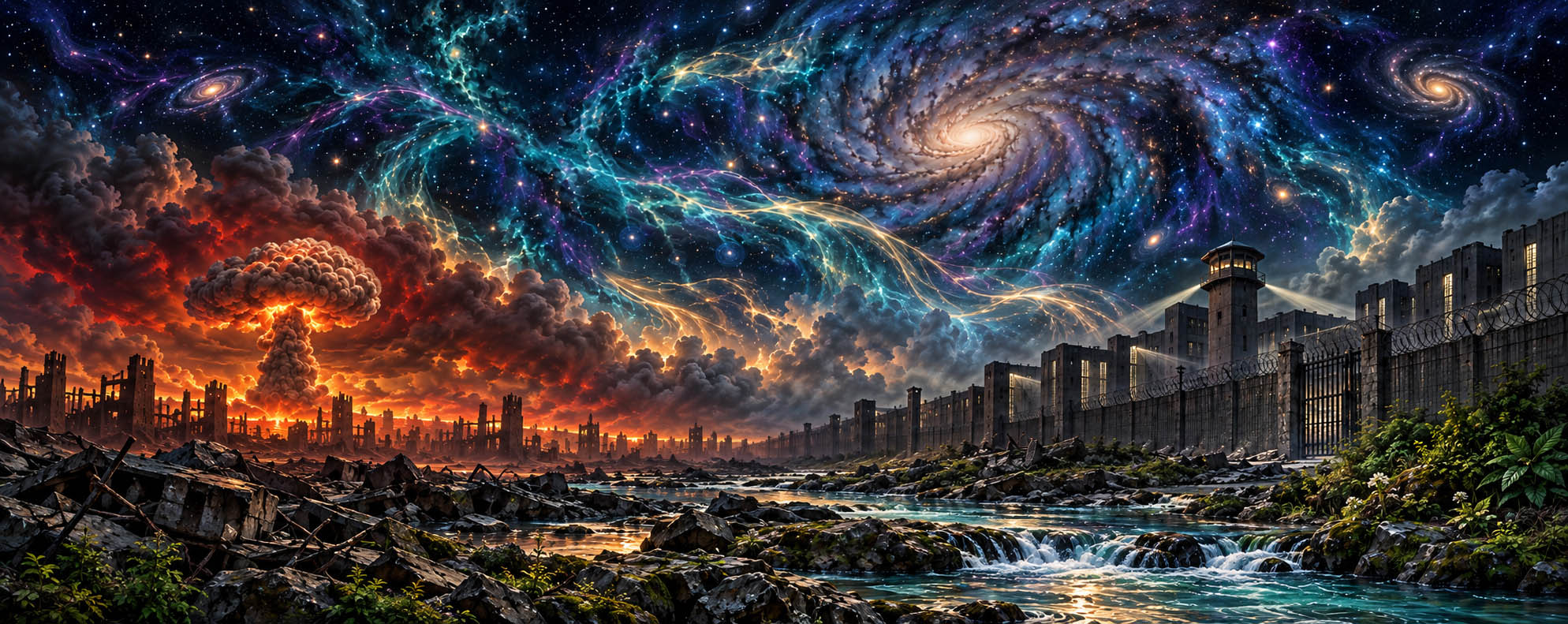
Manifesto in the Name of the Sciences of the Spirit
The consequences of this theory, which is presented as a scientific demonstration, are considerable because it may lead to another way of perceiving, thinking and, perhaps, feeling. For a start, the materialist assumptions that scientific thought itself had created and upheld for centuries would be refuted, rendered obsolete and scientifically demonstrated to be erroneous. For this work, which we know has been very meticulous and painstaking, our scientists undoubtedly deserve congratulations.
From a philosophical and spiritual point of view, we must welcome the fact that the sciences have found a corresponding point of convergence, for, after Romanticism, which was the swansong of Western thought, we have seen nothing but nihilistic or materialist ideologies which, alienated from spiritual reality, have contributed to the general bewilderment.
In fact, we find the underlying presence and pre-eminence of Consciousness or Spirit in Nature, in countless variations, from the dawn of humanity, in all mythologies and religions, and philosophically upheld in Western Idealism for some 2,500 years, and in the East for a little longer (see Parallel Civilisations); it continues to be upheld within a philosophical framework by contemporary authors, such as the author of this article. Strictly speaking, what scientists have found is a reality that transcends time and space, that is, metaphysics, an ancient discipline that has concerned philosophers for twenty-four centuries. In philosophy, then, we did not need this scientific verification, which appears as a discovery and a novelty only in a sphere unfamiliar with spiritual reality.
We can only regret that this discovery has come a little late, because in the name of ‘philosophical and scientific’ materialism we have suffered brutal dictatorships that have produced millions of victims, and we still see other dictatorships with concentration camps for all those who do not believe in the ‘scientific evidence of materialism’ and which, being in power, will scarcely accept the new theories.
In their long search among brain cells, the sciences of matter have not found where intelligence is generated, but have discovered it outside the mind. This means that the mind would no longer have a creative function, as has been believed for centuries, but a receptive one. The brain, which we identify with the mind, would be another sense, like sight or hearing. Curiously, this is what Hindus and Buddhists have always thought. But we know that Western culture has remained apart from Eastern knowledge, in the belief that the ‘true’ sciences of matter, as well as philosophy, religion, art and psychology, are Western. I confess that I have had the good fortune not to fall into this provincialism.
Well then, the brain would be another sense, but certainly one with far more complex functions, such as the ability to order everything perceived. For this ordering I have distinguished two interrelated faculties with different functions: one is the external part of reason, discernment, which fulfils the mechanical function of joining, separating and comparing, for which it depends on memory. The other faculty is the intellect, which fulfils an intermediate function, since it feeds discernment through intuitions that it draws from the Consciousness of the World; there is also a plane of direct perception, ignored by psychology. (For a detailed explanation of these mechanisms, I refer the reader to my Psychosophy and my theory of knowledge.)
Now, it remains to explain what this Universal Consciousness is and how it expresses itself, this Consciousness that permeates, illuminates and inspires the particular consciousnesses of all beings, which the sciences have just discovered. Well, for precisely half a century I have been speaking of this Consciousness, explaining and detailing its functions in the Cosmos and its relationship with our particular minds, and, conversely, the ways, conditions and methods necessary for our individual consciousness to gain access to It. Here, of course, I can offer only a few guidelines; but let the attempt be worthwhile.
Hypotheses, until proven true, are beliefs, and knowledge comes through experience, both in the sciences of matter and in those of the spirit. But the latter, the sciences of the spirit, are of a different nature: their knowledge is not acquired in laboratories or at desks, but with a different mind, different feelings, purposes and life. Aesthetic perception, moral practice, religious feeling and philosophical intuition are paths devoid of matter, on which no apparatus can rest and which it cannot even detect. The scientific method is cumulative, and neither can anything be accumulated along that path. Reason, which, as I have already indicated, is dualistic, has divided the way of knowing into two: subjective and objective; but, beyond reason, my theory of knowledge (to which I refer the reader) has set out a method that transcends this duality, which I have called unitive, and which is entirely spiritual in nature.
The difference in the case of the idealist philosophers whom I have discussed in my works is that each of them, in his own way, has had a transcendental intuition or a direct experience of that Consciousness, and it is from this that they deduce their philosophies. Physicists and scientistic philosophers have followed an inductive path; idealists, a deductive one. The former infer that there must be a Consciousness; idealist philosophers know that it is the first reality and develop their philosophies from it. The difference in perspective and method is radical and vital.
It follows from what has been said that it is not enough to discover something we can label Consciousness and from there begin to think, or continue thinking, about what the World must be like; rather, we must awaken and actualise that Consciousness. Quantum physics faces this challenge. Since reason is dual by nature, if a Consciousness has been reached through it, however much it may have been concluded that there is a Unity, this will remain a concept there; it will not bring about a vital transformation. Thinking about consciousness is not the same as thinking from Consciousness, Being Consciousness.
I have heard of some scientists who, now finding themselves, thanks to the quantum, confronted with a reality of a spiritual order that transcends matter, have begun to philosophise. I see nothing wrong with this, but I greatly fear that they will reach no more than hypothetical realities as long as they continue to use the scientific method, applicable and effective in the understanding of matter, but sterile in matters of the spirit. And not only the method, but the very mental faculties used by scientists are unsuitable for this purpose.
I shall take as a reference one of the most distinguished scientists, Mr Roger Penrose, Nobel laureate in physics, a person of very wide-ranging knowledge, extending from the most distant galaxies to subatomic particles. His discoveries are astonishing, it must be admitted. For example, he tells us that our own bodies are made up of atoms that belonged to galaxies millions of years ago; that is to say, we are part of the Cosmos. This surprises me because it coincides entirely with my cosmology, but I observe that it expresses only the material relationship; it remains to explain why those atoms seek or are driven towards an Order, for everything indicates that there is a force underlying matter that tends to stabilise and create; otherwise there would be Chaos, in which existence is impossible. Why have those atoms organised themselves to generate life? Do we living beings not feel a vital impulse that not only maintains the beating of our hearts, but leads us to love, to know, to create, that drives us, in short, beyond ourselves, that is, to transcend ourselves? It is these unitive forces that the sciences lack in order to complete their understanding of the Cosmos.
Of course, our defence of the sciences of the spirit cannot be indiscriminate. We know all too well that man has managed to distort these disciplines too, but this is the product of dogma, which is precisely a consequence of the pre-eminence of the utilitarian faculties over the unitive ones, to the point of generating a mental blockage within discernment, which, moreover, knows only exclusivist dualisms: God and man, spirit and nature, heaven and hell, the faithful and the infidels, the damned and the saved, false and true doctrines, etc.; this makes it irreconcilable with the unitive faculties.
By the same mechanism, the sciences of matter have also fallen into the dogma of reason, which, being an external faculty, accepts as ‘truth’ only what is verified in matter; that is to say, the ‘true doctrine’ is materialism, which has come to be made almost into a religion.
In short, it is evident that what is respected, predominates and has decisively triumphed is materialism; and, more seriously, it has come to materialise minds. That is why our fellow human being has been turned into an object, Nature into an object of exploitation, reality has been reified, and there are even clear symptoms of mechanised minds, observable in multitudes who take pleasure in listening to repetitive electronic music, literally monotonous and devoid of melody.
In truth, what we most need from the sciences and present-day technology is for them to stop producing devices of destruction and extermination. Unfortunately, they have already created them. What the times require, then, is precisely an inner change, which is what I have been proposing in my work. And this change does not come about by transforming Nature (the basic premise of materialism), but by transforming our consciousness. With that premise we have inverted the order of things, the priority in the order of knowledge, which must evidently begin with the knowing subject, with the one who is, not with what surrounds him, as if we (and this is another false premise) had already reached our fulfilment and could dispose of the rest of living beings as we pleased.
Material progress is inevitable, but it is possible to prevent those who have progressed furthest from exploiting those who lag furthest behind, although this, as history proves, has never happened, nor will it happen until the human being changes his conduct, that is, until he emerges from his primitive mental stage of survival. In fact, he surpassed it long ago, but has not surpassed it in his mental state, and it is clear that he will not achieve this with more technology, which ceaselessly generates new means of exploitation. The answer, even if we do not wish to see or accept it, lies in the sciences of the spirit, whose objectives, as I understand and apply them, are these: to restore our dignity and humanity in society and integrate us into the World.
If we perform a real act of awareness, we shall admit that hopelessness, the lack of meaning in our existence, the very anguish we try to conceal with immediate pleasures and entertainments, and the very nihilism we profess, are clear signs of inner involution. Could it be from ourselves that we wish to be distracted? Everything seems to indicate that the more we dominate Nature, the more we alienate ourselves from our own nature.
It is easy to judge physicists and the politicians who urge them to apply their ingenuity to diabolical inventions without taking responsibility for our own condition. Everything seems to indicate that, in our progressive identification with our external faculties, created by and for matter, we have failed to notice that we have undergone a process of alienation from our spiritual faculties; it is this process that has led us to place our faith in matter, to the point of confusing what we are with what we have, and thus to dehumanise ourselves. This must be clear: to the extent that we are alienated from our unitive faculties, we are alienated from our destiny.
Several factors have contributed to the present way of thinking and believing, factors that have, of course, been ignored; as we know, it is ignorance that has caused and will continue to cause the greatest evils in our species, yet we continue to fall into its nets. I shall try to summarise them, beginning with the psychological factor.
The net into which our scientists had fallen was woven several centuries ago by reason itself, which has led them to take a logical conclusion as a principle: the famous cogito ergo… ‘therefore I am’, ‘therefore’, exists. Yet I had already pointed out in my first work, The Return to the Sources, almost half a century ago, in the chapter I Think, Therefore…: ‘The Cartesian principle refers us to our individual perspective and thus to our world of abstractions. The principle of a philosophy cannot be a product, something constructed or elaborated, but, on the contrary, something as simple and solid as a foundation stone. Philosophy would be the development of what is evident to us precisely because of its simplicity and Unity. An authentic principle should not need proof or demonstration, because it must be so indubitable to us that it has no need of them. If the principle is preceded by a therefore or a consequently, it is no longer a principle but a result. I do not exist because I think; rather, I experience myself living; there is an evidence of life that precedes my thought.’
Another factor, very poorly understood, as was to be expected, is the philosophical one, a factor concerning which the very thinkers in this discipline, instead of resolving it, have contributed for two centuries to the general misunderstanding. Kant had demonstrated incontrovertibly, and for all time, that reason cannot go beyond the material, phenomenal world; to transcend it and enter noumenal reality, other faculties were needed, and these are the ones I have called unitive. It is these faculties that idealist philosophers in general have possessed and applied, even if they did not know it.
The deviation began with Hegel, who did not listen to Kant, to the point of constructing a philosophical system on the premise that ‘the real is the rational’; the premise was arbitrary and insufficient, but ‘scientific’. That house of cards, of course, collapsed. Unfortunately, the matter did not end there: on the one hand, with the cards scattered on the floor, ‘scientific and philosophical’ materialism was constructed, whose damage we have already pointed out. On the other hand, since Hegel had been regarded as the greatest exponent of Idealism, which only proves that this doctrine is not understood, the collapse that swept him away marked the beginning of scepticism about the Transcendent on the philosophical plane, aggravated on the religious plane by the proclaimed death of God. This also proves, on this plane, a lack of understanding, for it is the Christian God they have buried in their minds; there are other visions of God, or of the Transcendent, which our hasty agnosticism has prevented us from understanding (on this religious factor, see Parallel Civilisations).
To these psychological, philosophical and religious misunderstandings we must add the Industrial Revolution, which diverted our attention towards the means and made us forget the ends; and, most alarmingly, we are not aware of the gravity of this forgetting. The result is that only secular reality has remained. This forgetting of the ends has led to progress for the sake of progress, that is, to progressivism which, being ignorant of the ends, projects itself in every direction, so that it builds on the one hand and manufactures the means of destruction on the other; and this is the product of reason without wisdom. Restoring the priority of wisdom is the function of philosophy properly understood, which I have spent decades trying to restore.
The faith that had been placed in the dominant religion, which has ceased to hold sway, was transferred to matter and to those who transform it. Ortega y Gasset observed that, if an extraterrestrial were to ask who the most intelligent beings on this planet were, everyone would point to scientists, not to Plato, nor to the Buddha, nor to Beethoven; even to find out what happiness is, they would turn to the most renowned, to Einstein, the very same man who, in a registered letter, advised Roosevelt to manufacture the atomic bomb. I shall not be the one to deny his genius or that of atomic physicists, but it is my duty to highlight the negative consequences of their discoveries and their way of thinking. We also know that this same bomb has been improved and multiplied, and that the means of launching it have been perfected, so that the destiny of our species can now be decided in a few minutes; and this is far more than a lack of wisdom, it is rational insanity, for there is no shortage of reasons to justify this madness.
It should be added that the intelligence quotient, as it is usually measured, has little or nothing to do with our humanity; there are compelling examples of this. Darwin himself did not hesitate to affirm that what defined us as human was our morality, the spiritual faculty par excellence. Whether scientist, artist, politician or beggar, it is by his virtues that we must measure man first and foremost.
That is to say, what truly defines us is the spiritual faculties, which are precisely those we have forgotten, because for several generations now we have been directing our attention, interests and knowledge towards material goods, without noticing in this process our progressive alienation from ourselves, our fellow human beings and Nature.
Yet we persist in seeking technological solutions. If, instead of eliminating the means of mass destruction, we continue to manufacture them, it is because we are on the road to our own extermination; and it is not by improving anti-missile systems that we shall prevent the disaster. We cannot remain passively waiting for some invention to come and solve our personal problem, which is the real and decisive one. For the good of society, I am making an appeal to our personal responsibility. Enough distractions; either we put an end to this carnival or it will put an end to us.
I shall never tire of insisting that we are not equal to the circumstances we have created. A striking present-day proof of this is the panic aroused by AI, for the simple reason that it is already apparent that no one knows quite how far it will go or how far it will take us. I could pause here to point out the dangers it entails, but this matter is already being heard and read about everywhere, for it is known that it will affect every sphere of society; even the politicians and businesspeople in power, who can use it to their advantage, are concerned, a clear sign that it is getting out of our hands.
With regard to this new invention, I should like to highlight a relationship that seems to have gone unnoticed but which, from the perspective of my Psychosophy, becomes clear: it is an extension of the most external faculty of reason (by which I mean discernment), in which contemporary man has become confined through his obsession with material utilities. This faculty is indeed dual by nature, and its field does not extend beyond the physical world. The binary system of AI is the product of the least creative faculty we possess; it is not surprising that it has no intelligence. In the human being, however, discernment is not disconnected from the intellect, which sometimes draws nourishment from feelings and intuitions that transcend reason, enough to bring the spirit closer to the spiritual faculties I have called unitive, because they tend towards the unification of the mind, faculties that arise from moral, aesthetic, religious and philosophical consciousness. But this is not the case with the now famous AI, which is wholly ignorant of these higher faculties that are precisely what define us as human; for that very reason, it will tend to dehumanise us.
Of our faculties, the one in which AI proves most effective is memory, but our memory is charged with feelings and lived experiences that this device does not register; far from recalling them, it will tend to make us forget that indispensable nourishment of the soul, to robotise us still further. Perhaps the most harmful aspect of this invention is that it turns people into a mass, for it serves everything up ready-made to the user, generating a passive attitude so characteristic of mass-man. If we are not prepared to discern and resist the influence of the media of propaganda and dissemination, which have already indoctrinated and stupefied us, if we are already ‘mediatised’, we shall be far less prepared to face this threat that is already under way: AI. (See The Triumph of the Masses.)
Specialisation, which is progressively increasing, is one of the characteristics of contemporary society; perhaps it is inevitable and necessary for society, but the specialist seems not to notice that he has become a small cog, leading him to narrow his cultural, intellectual and spiritual horizon, to remain enclosed within a tiny earthly space; in other words, alienated from the universal and perennial, that is, from philosophy. Added to this is a present danger lurking: many specialisms will be replaced by AI; if the specialist is vitally bound to his profession and happens to be replaced, his demoralisation will be total. Perhaps more than ever, man needs the sciences of the spirit, which do not depend on novelties, which reflect what is eternal in our being, what we are and what endures; they are our refuge in the face of constant and astonishing change.
For more than a century, The Decline of the West has been proclaimed, coinciding with material progress. Everything seems to indicate that the more scientists and technologists think, the less people in general think, becoming passive and dispirited. If we add AI to this state of mind, we shall witness a society of people obese in body and spirit. I am not suggesting that the former should stop thinking, but seeking to encourage everyone to think better about the present situation.
The responses to this threat will be many and varied, but this in no way alters my proposal; rather, it intensifies it, for it precedes particular responses and provides their foundations. In any event, I believe it is evident that knowledge of spiritual reality, particularly if presented as self-knowledge, within a framework of freedom of belief and expression, presents far less danger than knowledge of matter.
Well then, what is my proposal? To rise to the level required, it is more than timely, it is necessary, to awaken another consciousness, and it is this that I am expounding. The times demand the development of a higher and more balanced consciousness. This means, among other measures, that education, which is today directed towards the advancement of technology, should turn towards the sciences of the spirit. If the ideal of reinstating the sciences of the spirit could be actualised, we should be in a position to attempt the definitive solution: to awaken Universal Consciousness.
In his famous book Cosmos, Carl Sagan passes through Greece and discovers some ingenious utensils and tools. It would seem that, for scientists caught in rationalist and materialist nets, the vision of the Cosmos begins with the first utilitarian inventions. Again, gentlemen, this is not so: the Greeks soared to heights that even today we cannot comprehend. For them, the Cosmos began with the Transcendent (beyond reason), with the Immortals and their struggle to establish the universal Order, an episode sculpted on the frontispiece of the Parthenon (a work destroyed by Christian fanatics). This Order and its temporary disruption are expressed throughout Greek art (which we have yet fully to understand) and, sublimely, in Greek tragedy, which has found no parallel since. Have we asked ourselves why it attained that degree of perfection? Because it brought together psychology, mythology, religion, literature, imagination, a philosophy of life and other virtues expressed as Art, so that it contained what is most essential and decisive in our nature, what is indispensable to our humanity, that is, the sciences of the spirit. (See Tragedy, in The Roots of Art.) The invocation of the Muses had been an obligatory tradition among writers from Homer to the Renaissance. Today it may be thought that this was mere rhetoric, but for more than 2,000 years poets were convinced that their inspiration came from on high; and this conviction cannot be explained as ‘belief’, but as communication with the Transcendent. (Op. cit., The Invocations.)
We must thank the sciences and technology for having enlarged and improved the stage of survival, that is, our animal stage, but the error lies in attributing to them functions beyond their capacities, in believing that we are evolving in every sphere thanks to external or material improvements. No, gentlemen, we are simply enlarging the human anthill; we are not emerging from it; rather, the more it grows and improves, the more enclosed we are in our anthropocentrism and selfishness. The path to follow, as will now be clear, in order to go beyond this anthill, is that of the sciences of the spirit.
There is no opposition between these sciences; they simply fulfil different functions: whether we want more comfort, conveniences and devices, both constructive and destructive, or whether we opt for more goodness, beauty, social and international integration, inner and outer peace, humanity and wisdom. They answer to different faculties, interests, means and objectives. One is the fruit of systematic reason and the study of matter; the other, of a primarily contemplative life, which generates other ways of perceiving, thinking and feeling. Afterwards, if one wishes to philosophise about the experience acquired, systematic thought is also necessary, but always adapting reason to spiritual experience, and not vice versa; this is the method my philosophy has followed. It is not a matter of one science or the other, but, for the reasons given above, the priorities must be clear. The reason is simple: when the sciences apply themselves strictly to matter, they have no need of immaterial reality; they therefore tend to dispense with spiritual values, and it is then that errors begin, not in their science, but in its application, in its use, and this is a problem that concerns the sciences of the spirit, particularly morality.
It is not only a matter of abstract values. In dealing with the sciences of the spirit in my Psychosophy, I am referring to consciousnesses, which are constituent parts of our mind and nature, the inescapable reference points for thinking, feeling and acting. Moral, aesthetic, philosophical and religious consciousnesses are the transcendent faculties that connect us with the Cosmos that we are. To be conscious is not merely to be awake and possess reason and memory, but to have these unitive consciousnesses present and active. Our awakenings of awareness, which illuminate and ennoble our knowledge, depend on them, and, conversely, to lose contact with them is a loss of consciousness; this is what I understand by alienation. Agnostics should consider this way of seeing the mind and reality.
It would not be surprising if these new scientific hypotheses, and even my own work, were now to generate an ideology of panpsychism, a little more interesting than those currently in use, but it would amount to no more than another intellectual fashion. For it is not by enlarging our self or habitual consciousness, but by transforming it into another Consciousness, higher in every sphere, particularly the moral, that we must proceed, for it is clear that, if we remain the same, disaster is foreseeable.
Perhaps everything can be reduced to this evident fact: our species is much closer to its destruction than to attaining its fulfilment, that is, happiness and wisdom. It is clear that we are following the wrong path, and that to follow it to the end is senseless. The answer follows with equal clarity: a change in vision and action is indispensable, perhaps impossible to postpone.
This change will take place only when we have the vital experience (lived experience) that the Good and the Beautiful, as Plato perceived, are creative principles; Plotinus, and the author of this manifesto, confirm it. When we know and feel that we are an extension of a universal moral Order. And this, as I have emphasised in my commentaries on Idealism, is nothing new: Fichte strove to demonstrate it. (See The Roots of Morality.) The fact that we have not attained this transcendent morality must not lead us to disconnect ourselves from our immanent morality, which is there to indicate our present path, the very same path that leads us to transcend ourselves.
Schelling, for his part, saw man’s transcendence through art, as did Schiller and the Romantics in general (see The Roots of Art). Shortly afterwards, Rubén Darío exclaimed: ‘Art is the glorious victor. It is in art that space and time are overcome’; and they attracted numerous followers; but it was then that the materialist straying began.
It is legitimate to observe and study the universe as a mechanism, but that is its visible part, to which mathematics and physics can be applied; there still remains that which permeates the universe, the Spirit that animates it, Life itself, in which everything participates, for every existing being, every cell, needs to be sufficiently conscious to be in the World. And this Intelligence-instinct is only one of the emanations of universal Consciousness, emanations perceptible only with the appropriate faculties, when these are brought to a high level of awareness, attained far beyond reason.
It will be understood that I am not opposed to the work of scientists; I have only wished to point out its limits. It would also be unfair to many of them who have not lost their humanity and who are already venturing into the spiritual sphere. With more than twenty of them I have shared a book, Exploring Consciousness, in which I summarise my conception of universal Consciousness, from whose perspective the aforementioned priorities are clearly set out.
Kant had pointed out that the basic principles or indispensable reference points for rational thought are the forms of time, space and causality; the significance of this framework of reason is of paramount importance for understanding our mind and the knowledge derived from it. Atomic physics has been able, with very complex apparatus, not only to split atoms but also to experience the behaviour of subatomic particles. In this way, it has verified that, when these particles are not observed, their behaviour is different. I would venture to say that this is not exactly so, but that, when a particle is observed through reason, reason applies the law of causality to it, and the particle conforms to this, to the observer’s rational vision.
What is interesting about the matter is that this experiment, in any event, seems to indicate that it is there that matter ends, and with it reason, and immaterial or spiritual reality begins, a reality that transcends reason. It is this other reality that I have called unitive, because reality appears unified. Atomic physics, reason and matter have reached their limit. To go beyond it, other faculties are needed, the unitive ones, and it is here that experiences of a spiritual order begin, experiences that belong to the domain of philosophy. These experiences correspond to another mind, another consciousness, which does not think in parts, does not compare this with that, places matter before us in a place and a time, does not discern cause and effect dualistically.
Following Penrose’s explanations of quantum physics, it reaches a limit that it cannot explain, although it can observe it, at which subatomic particles can be at astronomical distances and yet remain connected. Not being a scientist, I have not followed a rational method, but an intuitive one, which presents all reality as unified. This would explain why particles are here and there and everywhere, because they belong to a Consciousness, to a Unity that is not material but spiritual. This can be experienced when consciousness comes to be unified, certainly not individual consciousness, but Universal Consciousness.
Scientists never cease to marvel that, in the long and extensive cosmic process, a species has appeared that becomes aware of the physical and mathematical realities which explain to a large extent macrocosmic and microeconomic material reality. It is indeed marvellous, but they tell us nothing of this species becoming aware of the Consciousness of the World, which is the most transcendent discovery in our history.
A basic principle of my philosophy of mind, that is, of my Psychosophy, is the existence, I would say the pre-existence, of a Consciousness of the World, in which everything living participates; for the human being, this presents itself as evident through experience of a spiritual order. The scientific experience described leads me to conclude that this discipline too demonstrates, in its own way, the participation of human consciousness in Universal Consciousness. The two experiences mentioned seem to confirm it: participation in the phenomenon of subatomic particles that behave as matter as well as spirit, and the fact that an electron can connect with another at astronomical distances, are due to their being part of the Consciousness that encompasses the Cosmos. Whereas our body is limited to the time and space in which we find ourselves, our mind can travel in an instant, thanks to memory, to another place we have known personally, such as the Athens we have visited, or to the Athens of Pericles that we have studied. We can also travel without limit in our imagination; we can think about atoms, compose a poem or a symphony; the mind is free and can be here or there in an instant. And we can do this because our faculties participate in a Universal Consciousness which, naturally, has no limits.
But, of course, this Consciousness is not like ours. We have always intuited it, because we use it continually, although unconsciously. We have imagined it wrongly by projecting our individual mind, which is limited by the senses and the faculties we have developed in order to subsist: reason, will, memory, feelings, etc. Thus, from this individual perspective, it is very difficult for us to conceive of a transcendental Consciousness. It suffers no needs because it is the Creative itself; it has no will in the animal manner, it simply creates, emanating the spiritual substances that generate spiritual and material existence. It is legitimate to ask why Creation exists, but we would be interposing the principle of causality; we may also think about when and how it occurred, but we would fall into spatio-temporal reality, that is, into our individual consciousness, from whose perspective Unity becomes fragmented and fades away.
I observe that the laws of entropy have atomic physicists very concerned, for they indicate that all existence will have an end. I confess that I do not quite understand this concern, for without much science we know that time swallows everything, particularly in our very brief lives. As I see it, those laws show only one side of the coin; the other side, which is the one that concerns everything living, shows that life is continually generated and continued. A cup that falls to the floor and shatters, those laws tell us, cannot return to its original state; that is true, but life reproduces itself, not identically but very similarly, and can also improve, just as a tree can be larger and more vigorous and bear more fruit than its predecessor, which dropped the seeds. There is also an Evolution of Species, magnificently explained by Darwin, and an Evolution of the Spirit, developed in my work. And there is also a vital energy, generating life, which is undoubtedly decisive and primordial for all living beings within the immensity of the Cosmos. Schopenhauer explains it as Will and, more aptly, Bergson calls it élan vital. Having already analysed these philosophers in my work, I shall not dwell on them here.
In my conception, vital energy is a primary manifestation of Universal Consciousness, and its existence can be experienced by the human being at a high level of awareness. Other primary manifestations of this Consciousness, particularly Intelligence-instinct, Order and Love, make life possible. These universal energies show the opposite side of entropy, for they constantly animate the Universus (spiritual and material Reality) and tend to establish an Order and equilibrium, or to restore it after temporary disorder. We observe that there are centrifugal forces, which disperse and multiply, and centripetal forces; neither Schopenhauer nor Bergson speaks of the latter, even though it is in these that Spirit best manifests itself, for they bring together and unify, so that these opposing energies find a balance. There is a syntropy permanently at work that prevents chaos from becoming established, establishes the equilibrium necessary for the existence of the Cosmos and makes life possible. As I perceive it, this is the function of universal Spirit. Matter is imperfect, that is its condition, hence its entropy, but a syntropy allows infinite forms of life to be possible over billions of years, in billions of galaxies; therein lies the Issue, not in the end of matter, but in the realisation of the spirit. That is to say, if we can overcome our present state, dominated by the familiar passions that threaten our future, we have all the time in the world to attain our Destiny.
I believe this is what truly matters to living beings. Everything may disappear, but life will appear again. The famous Big Bang may have occurred, but there must have been others before it, for if the infinite is incomprehensible to the human being, it is far more inconceivable that there should have been nothing but Nothing before the cosmic explosion we know. There is a constant, a regeneration; we can experience this if we change consciousness: Universal Consciousness presents itself to spiritual experience as an eternal present, pouring into time and space as immaterial energy, generating subtle matter imbued with Spirit, ready to animate and continue Life.
In his latest presentations, Mr Penrose confesses that the great Problem facing the sciences today is that of consciousness, and even wonders whether there might be a consciousness spread throughout the cosmos. But he admits that this is as far as he and the most advanced sciences can go. What is decisive is that the sciences have opened a door leading to immaterial reality, which is where the sciences of the spirit draw their nourishment; and it will be understood that I speak in the name of these sciences within a philosophical framework consistent with the sciences of matter.
The sciences too, from their perspective, could investigate the link between Consciousness and the immaterial realities to which they have access, particularly photons, for intelligence, intuition and inspiration have always been linked to light in the religious and artistic spheres. That the Egyptians, Greeks, Hindus, Incas and Aztecs have worshipped or continue to worship the sun is more than a clue. Moreover, the gods associated with the sun as matter, Phoebus and Surya, and, more than with this, with light as spirit, Apollo and Vishnu, represent Intelligence itself (and to think that the Greeks and Hindus are naïve is to express our own naïvety). And those same spiritual faculties lead me to establish that link. I have already suggested in my cosmology that the stars, besides producing the heat and light necessary for life, spread intelligence (they do not create it); photons could be vehicles laden with intelligence that nourish the consciousness of animate beings. But I leave this idea in the hands of scientists, for it would be marvellous if these sciences were to end their disagreements and conclude with a fraternal embrace; this is, ultimately, the purpose of this Manifesto.
Mr Penrose also endeavours to demonstrate why religions exist, and does so in the classical manner, taking the most widespread religion as his reference; this is the first error, into which Toynbee and so many others had already fallen, because in this matter quantity does not determine quality. The second error was foreseeable, for it is the same one the Church makes: taking an entirely spiritual moral message as actual events. I have elaborated sufficiently on this subject in The Triumph of the Masses, so I shall not deal with it here.
I shall say only that what is decisive in understanding the religious noumenon is the experience of reality that transcends reason, which is what so many mystics and philosophers express. It is in understanding their teachings that the matter lies; it is legitimate to say: I do not understand them, or I am not capable, but it is not legitimate to say: I do not believe. There are no false or true religions, but relatively similar paths towards the same destiny. I in no way intend to justify the deviations and wanderings that have occurred along the journey, but they serve to remind us how far man is from reaching that destiny.
Some 4,200 years ago, precisely in the oldest sacred text that survives, the key to understanding this matter had already been expressed: ‘Truth (God) is one, but the wise (men) give it different names’ (Rig Veda, Book 1, Mantra 164, 46). Hindus have accepted this postulate as a matter of course ever since; in the West and the Middle East, it is still not understood (or there is still no wish to understand it). For those who are wary, we can clarify this postulate still further: God may be non-personal, have no will, intention or form, that is, may be entirely free of all anthropomorphism; in my vision, to avoid misunderstandings, I do not even speak of God. Nor does Buddhism have any need to do so.
Western Idealism has been as misunderstood as its Eastern counterpart, beginning with Plato. We find it difficult to understand that Plato is the philosophical distillation of Hellenic religion, because he elevates it to a transcendent plane that is not easily accessible. ‘Plato,’ Jaeger reminds us in his Paideia, ‘is the creator of the concept of theology, and the work in which it appears for the first time in world history is the Republic, (…) where the fundamental outlines of theology are drawn (…) this is a specifically Greek product.’ Well then, you now know where to find the roots of our religion.
In India, philosophy was never separated from religion, although they give priority to the latter, so that philosophy becomes another yoga, called jñāna yoga. Idealists in the West, Parmenides, Heraclitus, Plato, Plotinus, Spinoza, Ficino, Schelling, and my own idealism, likewise do not dwell on the difference, because they respond to the same experience. Idealism in the West is the equivalent of Vedanta in India, and of Buddhism, which are the most appropriate reference points for anyone wishing to know the religious noumenon. Indeed, in my philosophy I believe I have brought them to convergence, but my greatest effort has consisted in reinstating Idealism of Hellenic roots, which is in the soul of our culture, as demonstrated by the most eminent philosophers who have taken part in The Search for Universal Consciousness. But, of course, we are not referring to the religious phenomenon, to its external, popular or folkloric aspect; we are no longer on the plane of beliefs, but on that of experiences of a transcendent order, where the sciences of the spirit converge.
In my view, the most beneficial outcome that these scientific findings with which we are concerned can generate is to awaken a renewed interest in idealist philosophies, which are, quite evidently, those with the clearest view of the spiritual landscape and, for that very reason, those most conducive to knowledge of ourselves and thus to attaining an essential perspective that encompasses particular perspectives (see my theory of perspectives).
I have ample reasons for proposing a Neo-Renaissance; I consider it the appropriate means of emerging from the present lamentable state. The Birth (Greece), humanism in the Renaissance and the exaltation of feelings in Romanticism demonstrate a consciousness different from the rational one, far surpassing the materialist vision. It is these movements that have effectively generated the great rises in awareness in history, as my philosophy of history emphatically maintains (see The Evolution of the Spirit).
My work has the purpose of generating a radical change of perspective. It is not knowledge of the behaviour of matter that will produce this change, but knowledge of our true consciousness, after first going beyond the consciousness with which we have mistakenly identified ourselves. The priority is knowledge of our inner circumstances, which lead to the perception of the emanations of universal Consciousness, for it is these that bestow wisdom, and without wisdom there is no philosophy, and without philosophy (which we must not confuse with the ideologies in use in these times), societies fall apart.
The human being, in general, has become aware only of his individual consciousness; I shall never cease to insist on this determining condition. For this reason, he does not perceive the constant relationship he has with his transcendent Consciousness. According to my idealism, founded on my experience, I observe that, besides the intellectual or transcendental intuitions necessary for the perception of Universal Consciousness in Itself, the experience towards which all my work is directed, every creative intuition draws nourishment from a relative or partial perception of Unity, which is the Essence of the Universus. Moreover, I maintain that man orders his mind, his knowledge and his circumstances because he participates in some way in the universal Order. Unity is absolute Order, and this is the reference point for every ordering intuition. Newton’s apple cannot be understood if we think of an apple tree, but it makes sense if we imagine the mythical World Tree, expressing that Unity, that Order, the Creative. The more universal the intuition, the closer it comes to the transcendental intuition of Universal Consciousness in Itself, but this lies beyond the universe conceived by the sciences of matter.
There will be no shortage of those who say that what I call the sciences of the spirit are not sciences, since they are not demonstrable as the sciences of matter are. To this I shall reply: if there is any merit in my work, it lies in the effort I have made to ensure that they can indeed be experienced. I have stripped them of all creed, dogma, determinism, subjectivism, relativism, exclusivism and other isms; I have founded them on experience and have provided the means of attaining it through a theory of knowledge, a transcendental psychology (Psychosophy), an ethics, an aesthetics, a philosophy of history and a metaphysics. This experience of the Transcendent is not an invention of mine (my philosophy seeks truths, not novelties); it has been repeatedly attested for 2,600 years in Buddhism and Hinduism (the similarities and nuances in its interpretation have been duly highlighted in The Evolution of the Spirit and Parallel Civilisations). And, should this not prove sufficient, everyone is invited to contribute to the same purpose, for my philosophical system is open and its intention is to spread this knowledge in the conviction that nothing is more useful and necessary to our species.
My philosophy, which has sought to bring universal idealist thought to convergence and organise it, does not work with imagined or hypothetical ideals, nor preach the hope of finding ethereal or celestial worlds, but acts upon verifiable levels of awareness, generating spiritual experiences that lead to a vision displaying the whole of Reality, spiritual and material, the Universus in which we find ourselves and have our being. And it is in this Unity of Consciousness that the fullness of our mind and our existence is found. In the conviction that this is so, all my work is directed towards that Destiny.
17/11/2026
No responses yet